The First 25 Years
1927
1927
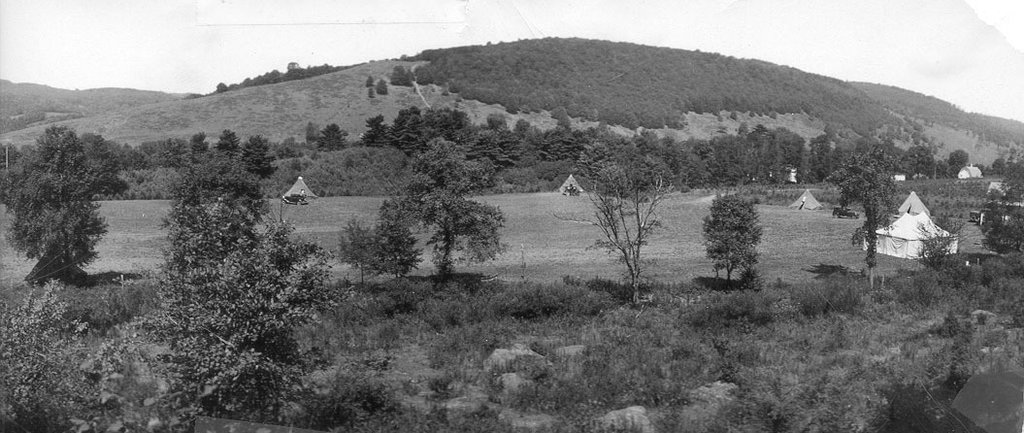
4-H Camp Shankitunk opened on July 1, 1927. The land was loaned to John A. Lennox (the 4-H Club Agent) by the Honorable John D. Clark. The only building on the land was an old sap house, now known as “the old nature lodge,” which is off limits due to the fact that it is structurally unsound. When camp opened, the sap house was used as a kitchen. A tent was used as a dining room, boards on sawhorses as tables, and blocks of wood as chairs. A contest was held to decide the name of the camp. The winner was to receive a free week of camp. Virginia Oestrich of Walton chose the winning name. “Shankitunk” is an Indian word meaning “Woody Place.” Campers didn’t have a pool. They waded in the river. Campers in the first few years received guided tours through the Clark Estate. The Clarks had a huge, beautiful house. Tents, cots, and dishes were rented from the Walton Armory. Camp was two weeks. 41 4-H members attended camp. There were five tribes: Seneca, Onondaga, Cayuga, Mohawk, and Oneida.
Title
01 Mar, 2023
1928
After the success of the first camp season, a more permanent set up for the camp was discussed. It was decided to lease ten acres of land from Mr. Clark for ten years. The rent was to be planting one hundred trees on the land each year. The dining hall was moved into the old sap house/kitchen. A fireplace and an outside entrance were added. There was still a dirt floor, but there was a U-shaped table with slab benches. Archery, astronomy, pack baskets, and moccasins were added as classes. Vespers was created this year, run by the campers out of a book called “Vespers in the Open.” After vespers, the campers participated in the camp fire by the “totem pole” and “council rock.” A third week was added for adults. There was a leader training week for adults. Campers washed their own dishes. Tribes chose their own names. There were bugler competitions; the prize being a free week of camp.
Title
01 Mar, 2023
1929
In the past, there had been a week for girls, a week for boys, and a week for adults. This year it was divided into older girls, younger girls and boys. There were about seventeen campers per day at the camp. There was a nurse this year, sponsored by the Walton National Bank. There was now hot and cold water in the kitchen. The County Agent’s father recommended a mascot for the camp. “Maggie the goat” came to camp that summer. There were four weeks of camp and 112 campers.
Title
01 Mar, 2023
1930
The pool was built. A swine house was given to the camp. A second story was added and the porch was painted white with green clovers. It was used as a craft shop originally, but is now used as the camp shop.
Title
01 Mar, 2023
1931
The Shankitunk 4-H Camp Committee consists of J.A. Rich, Agness Smith, Elizabeth McDonald, Reverend G.V. Barry, E.E. Guild, Honorable John D. Clarke, Charles Perry, and Leslie Streeter.
Title
01 Mar, 2023
1932
During girls week, the campers designed a rock garden to improve the visual quality of the pool where the grass had grown up tall. Many people donated flowers and plant furnishings to assist. Charles Franklin, of Delhi, was hired to start the project with the use of the “Camp Ford.”
Title
01 Mar, 2023
1933
A week’s stay at camp costs $7.
Title
01 Mar, 2023
1934
Floors were put in the tents. 130 campers and 19 counselors attended camp. Burgin bull visited camp.
Title
01 Mar, 2023
1935
Camp fee was raised to $8. If five or more from one 4-H club attended, a discounted rate of $6 was available.
Title
01 Mar, 2023
1936
Mr. and Mrs. Abraham John Jeremy, a Micmac Indian family, stayed at camp and taught basket making.
Title
01 Mar, 2023
1937
39 boys, 90 girls, and 27 counselors attended camp.
Title
01 Mar, 2023
1938
A new Recreation Hall was built by the National Youth Administration. This building is now used as the Craft Hall.
Title
01 Mar, 2023
1939
A drought keeps the pool from ever filling. The “Recreation Hall” (present day craft hall) was finished. Flush toilets were installed in addition to the old stone outhouse.
Title
01 Mar, 2023
1940
A new floor and addition are added to the dining hall. Tents were pitched in the pines planted as rent to Mr. Clark as opposed to in the field.
Title
01 Mar, 2023
1941
Earth Houses (mud huts) were built by the National Youth Administration Boys for the kitchen staff behind the dining hall.
Title
01 Mar, 2023
1942
Tribal names are changed to Army, Navy, Marine, and Air Corps. Instead of nature study and hikes new classes are offered: Home Nursing, First Aid, physical ability, victory gardens, salvage, and food preservation. The war is taking it’s toll even at camp.
Title
01 Mar, 2023
1943
Closing camp was considered, due to the war, but enrollment was it’s highest ever this year with 204 campers. Mr. Lennox left Delaware County for the state 4-H office at Cornell. John D. Merchant became 4-H agent and Camp Director.
Title
01 Mar, 2023
1944
Another drought caused the pool to leak. Water had to be pumped from the river. Girls had to help as counselors during boys week.
Title
01 Mar, 2023
1945
Harold Carley took over as 4-H agent. Electric lights, water heater, and a new concrete floor were installed in the kitchen. Betty McElroy, the assistant 4-H agent, had to serve as cook.
Title
01 Mar, 2023
1946
Mrs. Lennox, who had been at camp 19 straight years, did not spend the entire summer at camp. Fund raising began for the purchase of the camp.
Title
01 Mar, 2023
1947
Camp had health insurance on all campers for the first time. Classes were signed up for ahead of time.
Title
01 Mar, 2023
1948
$.33 was charged for each meal. 188 campers attended camp within four weeks.
Title
01 Mar, 2023
1949
146 campers, 25 counselors attended camp. New courses offered: recreation, leadership, conservation, and woodcrafts.
Title
01 Mar, 2023
1950
Government surplus food was used for the first time.
Title
01 Mar, 2023
1952
Archery is a new class.
Go back to Original Camp Schedule or see how camp grew in Years 25 to 50